
What’s the Best that Could Happen?
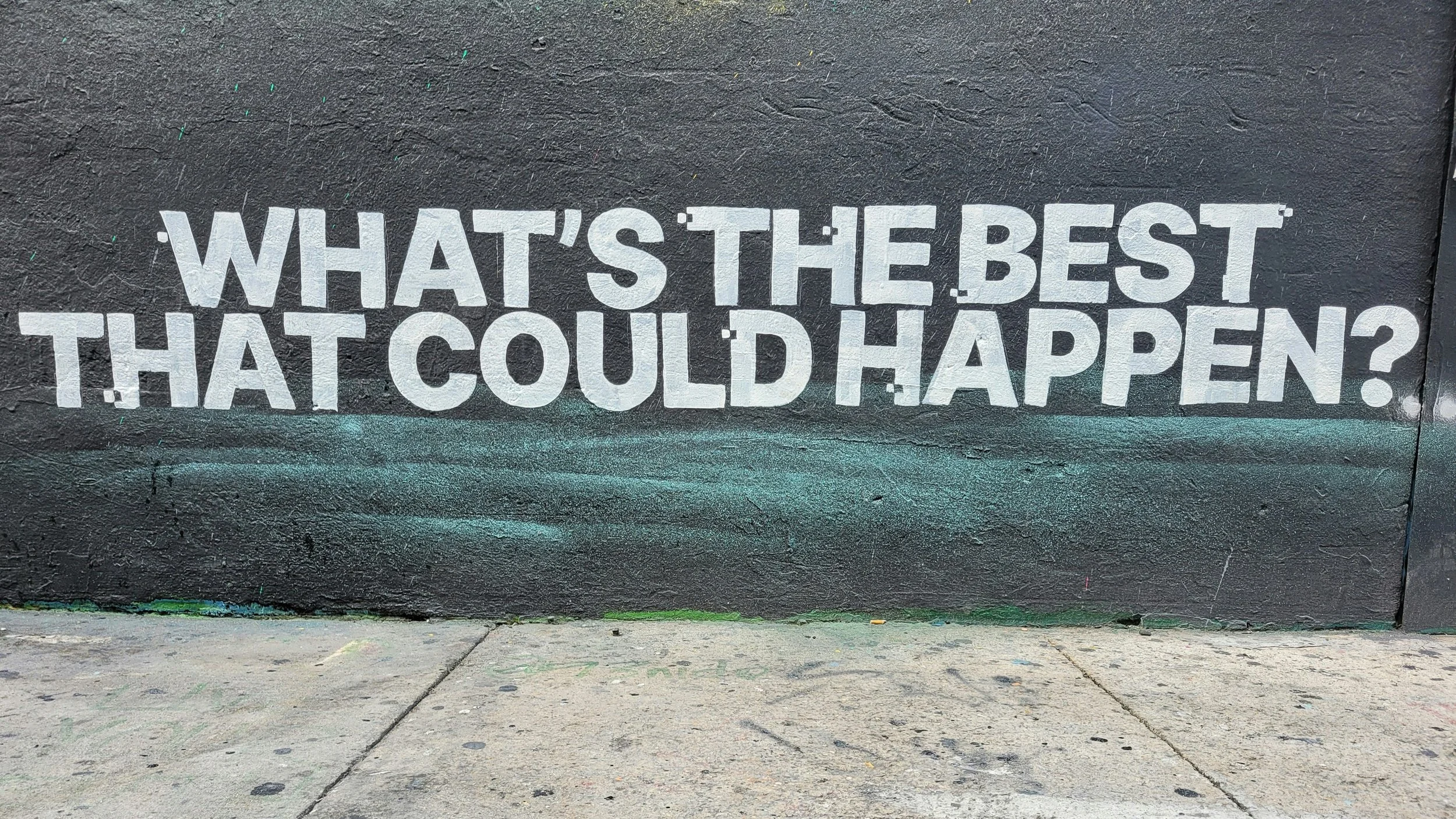
Last weekend I was in NOLA with my husband and another couple for French Quarter Festival. We had rented an Airbnb close to the quarter, and in the living room was a very interesting framed poster.
“What’s the best that could happen?” it simply said.
“You know, that’s a really interesting picture.” My friend remarked. “We’re always busy thinking about the worst that could happen. But what would happen if we flipped the question around?”
It’s a challenge I’ve been ruminating on the last few days, and it brought up another memory. A memory from 2015, when I was thinking of starting True North, and I was getting some coaching from my favorite colleague and mentor at the company I was employed with during that time. I was struggling with go/no go decision of launching my own business. It was high stakes. I was paid well and had loads of benefits. These conversations were important, so in preparation for one of our coaching sessions, I had decided to capture down all my concerns.
Feed your dreams, not your fears
It was a long list. And in the run up to our conversation, I kept adding to it. We jumped on our call, and then I proceeded to relay all these fears to my mentor. He humored me for about a half hour, and then he finally said – “You’re feeding your fears Shelley, not your dreams.”
He was right. But it’s just so easy to catastrophize, isn’t it? And I’m not trying to downplay the importance of planning, the importance of thinking about risk and making calculated decisions – decision quality is very important, but the key is calculated. By trying to “harness” or “capture” all my fears (over-controlling and hyper-vigilance masquerading as risk management), I had inadvertently given birth to a monster. There was no end in sight.
Fear will grow if we let it
When we’re hooked by fear, the fear tends to grow. This isn’t just an emotional condition or a personality flaw. There’s a physiological aspect to it and it’s there for a reason – scientists often refer to this tendency to “get hooked” by fear as the amygdala hijack. I start to get hooked by fear or danger, my body starts pumping stress hormones like cortisol to address the fear, which all makes perfect sense if there is a real danger or a threat. I need the energy to power through; I need focus to combat the threat. If it’s a bear, I need strength to outrun the bear or to fight it. But the problem is that many of our modern-day problems have nothing to do with actual survival, and so our nervous systems remain amped up day after day, night after night, with no real end in sight. Because the thoughts keep coming, and our brains can’t distinguish a real threat from an imagined one. Yes, I just said that – our brains can’t distinguish a real threat from an imagined one. No human manages to escape this trap, no matter how smart you think you are.
And our brains stay particularly amped up when we unconsciously and obsessively ask ourselves versions of “what’s the worst that could happen?” I sometimes ask a coaching client this question with a tinge of flippancy, yet very intentionally – to make the point that there’s nothing all that bad that could happen. But when we’re hooked, we often don’t get that sense check, and our mind is off to the races.
We forget the best of ourselves when we only focus on fear
Lately mine has been more than I’d like to admit. I’m in a period of transition with my business, letting go of one aspect that has been safe, to focus more on growing my coaching practice. I’ve been so focused on the worst that could happen, that I haven’t even stopped to ask myself about the best. And when we focus too much on the worst, we forget our strengths. Or in other words, we forget the truth of who we really are. I had managed to lose sight of all the incredible work I’ve done, the things I’ve learned, the connections I’ve formed, the reputation I’ve built, the resilience I’ve gained, who I have become, which is much different than the version of me when I started True North all those years ago. It’s this version of me who is taking the leap, and the leap is a much smaller one than when I quit my day job and started my own business in 2015. But everything had been distorted through the lens of fear.
Now that the dust has settled on this front for me, I can see the boogie man in the closet for what and who he really is. He’s still there, he’s not completely going away, but I’m not shaking in my boots anymore. I’m grounded in my strengths, my abilities and the conviction that this change is aligned with my higher self. I’m finally feeding my dreams, and not my fears.
Coaching Questions for Thought:
· How might you inadvertently be feeding your fears and not your dreams? Think about how overcontrol and hypervigilance could be masquerading as risk management…
· For a situation that brings up anxiety, what strengths can you bring that will help you navigate when the seas get rocky? How will you remind yourself of these strengths?
Shelley Pernot is a life and leadership coach who is passionate about helping her clients heal burnout and lead from a place of purpose. She is particularly adept at working with high performing women perfectionists at risk of burning out. Feeling a little stretched? Take the 3-minute Burnout Risk Survey to see where you stand. Reach out to me here for a free consultation to learn more about the coaching process and how it may benefit you!